
How to Analyze Your Mock Test Results Like a Top Ranker
A 5-layer framework top rankers use to analyze mock test results — with a visual workflow, a progress tracker, and top-ranker habits, beyond just the score.
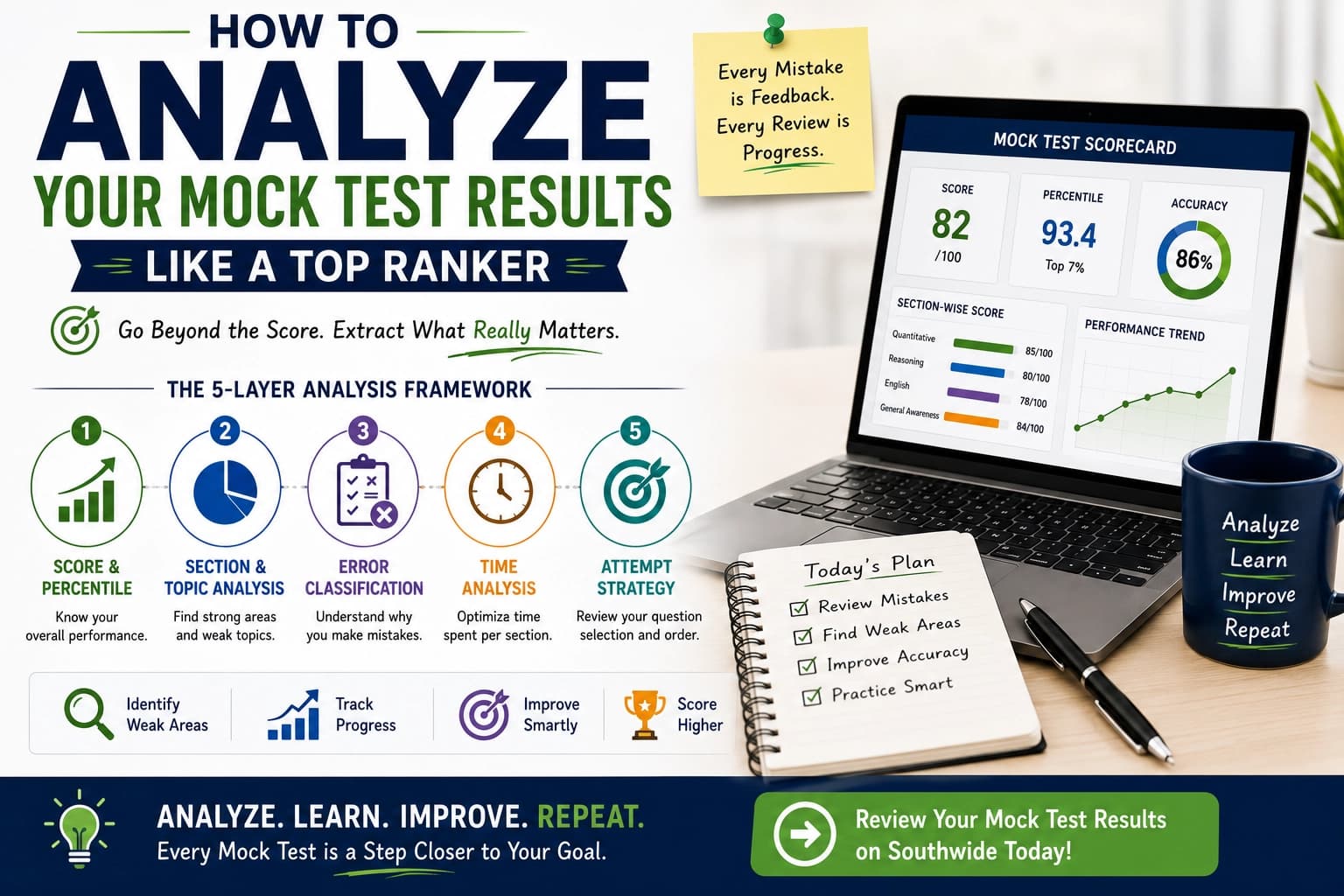
Top rankers don't just take more mock tests than everyone else — they extract more information from each one. Two candidates can take the exact same test, score the same, and walk away with completely different amounts of useful feedback. This guide shows you exactly how to analyze a mock test result the way high scorers do.
Editorial Note: This framework is based on common analysis methods used by experienced competitive exam aspirants. The exact metrics available may vary depending on the mock test platform, but the review process can be applied to almost any exam.
Who Should Read This?
Aspirants who are already taking mock tests but feel like their scores aren't improving despite consistent practice — usually a sign of weak post-test analysis rather than weak preparation.
Why Analysis Matters More Than the Score Itself
In short: your score tells you where you rank, but the analysis underneath it tells you what to actually fix — which topics are weak, whether you're losing time or losing marks, and whether mistakes are conceptual, careless, or driven by time pressure. Top rankers treat the score as the least important output of a mock test.
A mock test score is a single number that hides far more useful information underneath it — which topics you're weak in, whether you're losing time or losing marks, whether your mistakes are conceptual or careless, and whether your attempt strategy matches your actual strengths. Top rankers treat the score as the least important output of a mock test; the analysis is where the real preparation value lives.
Take a Short Break Before Reviewing
After completing a long mock test, take a 15-30 minute break before analysing it. Returning with a fresh mind often makes it easier to identify careless mistakes and poor decisions objectively, rather than reviewing while still mentally fatigued from the test itself.
The 5-Layer Mock Test Analysis Framework
Take Mock Test ↓ Check Score ↓ Classify Errors ↓ Review Time Usage ↓ Revise Weak Areas ↓ Take Next Mock Test ↓ Measure Improvement
Layer 1: Overall Score and Percentile
Start with the basics — your raw score, accuracy percentage, and (if available) percentile or rank compared to other test-takers. This gives you a baseline, but don't stop here; this layer alone tells you almost nothing about what to fix.
Layer 2: Section-Wise and Topic-Wise Breakdown
Break your performance down by section (quantitative, reasoning, English, general awareness) and then by topic within each section. This is where you start seeing patterns — for example, consistently strong in arithmetic but weak in data interpretation, even though both fall under "quantitative aptitude."
Layer 3: Error Classification
For every wrong answer, classify the mistake into one of four categories: a concept gap (you didn't know the required concept), a silly error (you knew it but made a calculation or reading mistake), a time-pressure error (you knew it but rushed due to time constraints), or a guessing error (you attempted without real confidence). This single step is what separates top rankers from average scorers — each error type needs a completely different fix.
Layer 4: Time Analysis
Review how much time you spent per section and per question type, not just your total time. Look for sections where you're spending disproportionately more time than the marks justify, and questions you should have skipped earlier but didn't. Specifically, track:
- Questions answered in under 30 seconds — check whether these were genuinely easy or rushed guesses
- Questions taking more than 2-3 minutes — these are candidates for "skip and return later" next time
- Questions skipped — were they correctly judged as too costly, or skipped out of hesitation?
- Questions guessed — cross-reference these with your error log to see how often guesses paid off
Layer 5: Attempt Strategy Review
Finally, review the order and selection of questions you attempted. Did you attempt your strongest section first? Did you skip questions you should have, or attempt ones you shouldn't have given negative marking? This layer is about decision-making under exam conditions, not knowledge.
Turning Analysis Into Action: The Weekly Error Log
Analysis without follow-up doesn't improve your score. Maintain a simple error log with four columns: topic, error type (from Layer 3), the specific concept or skill to revise, and whether it's been fixed in a later test. Review this log weekly, and prioritise revision time based on which error types and topics show up most frequently — not just the ones that feel most urgent.
| Error Type | What It Means | How to Fix It |
|---|---|---|
| Concept gap | You don't know the underlying concept | Re-study the topic from your primary resource, then re-test |
| Silly error | You knew it but made a careless mistake | Practice with a "read twice before answering" habit; track frequency to see if it's decreasing |
| Time-pressure error | Rushed due to running out of time | Improve section-wise time allocation; build calculation speed |
| Guessing error | Attempted without real confidence | Recalibrate your attempt threshold; skip more aggressively on low-confidence questions |
Track Your Progress Across Tests
A single test's analysis is useful, but the real value shows up when you track trends across multiple tests. Log your score, accuracy, main error type, and next focus area after every attempt:
| Test | Score | Accuracy | Main Error | Focus Next Week |
|---|---|---|---|---|
| 1 | 68 | 74% | Time pressure | Calculation speed |
| 2 | 74 | 80% | Careless errors | Reading carefully |
| 3 | 81 | 87% | Guessing | Better question selection |
Your own numbers will look different, but the format matters more than the specific figures — a shrinking, shifting error log across tests is one of the clearest signs your preparation is actually working.
Habits of Consistent High Performers
- Review every test within 24 hours
- Maintain an error log
- Focus on recurring mistakes
- Track progress across multiple tests
- Revise before taking another full-length mock
Common Mistakes in Mock Test Analysis
- Only checking the score. This skips all four deeper analysis layers and wastes the test's real value.
- Reviewing wrong answers but not correct guesses. A correct guess hides a concept gap that will resurface later.
- No consistent tracking system. Without a log, you can't see whether the same mistakes are recurring across tests.
- Analyzing once and moving on. Analysis should feed directly into your next study session, not sit unused.
Frequently Asked Questions
How long should mock test analysis take? As a general guide, spend at least as much time analyzing a test as you spent taking it — often more for full-length tests, where there's more to review.
Should I redo questions I got wrong? Yes, after understanding why you got them wrong. Redoing a similar question a few days later helps confirm whether the concept gap or error pattern is actually fixed.
How do I know if my analysis is actually working? Track whether the same error types and topics keep recurring across tests. A shrinking error log over time is a stronger sign of progress than any single test score.
Is percentile or raw score more important to track? Both matter, but percentile (where available) gives more context, since exam difficulty can vary between tests. Track the trend in both over time rather than fixating on one test.
Should I analyse every mock test? Yes, ideally. Even a short 15-20 minute review of every test keeps your error log current and prevents mistakes from going unnoticed for weeks.
How many mock tests should I review each week? Review every test you take, generally 2-4 per week depending on your schedule — the review matters as much as the test itself, so avoid taking more tests than you can realistically analyse.
Is a low score in mock tests normal? Yes, especially early in preparation. Mock test scores typically improve gradually as you close concept gaps and refine your attempt strategy — a single low score isn't a reliable signal on its own.
Should I compare my score with friends? It's more useful to compare your own scores across tests than against friends, since individual preparation stages, strengths, and study time differ. Use percentile only as a general benchmark, not a direct comparison tool.
How do I identify recurring mistakes? Keep a consistent error log across tests and review it weekly. Patterns that show up in three or more tests are worth prioritising over one-off mistakes.
How long should I keep an error log? Throughout your entire preparation period. Error logs are most valuable when you can look back weeks or months later and see which error types have actually shrunk over time.
Don't Let Your Mock Test End With a Score
Your score tells you where you are. Your analysis tells you how to improve.
Review your Southwide mock test results, identify recurring mistakes, and turn every test into a better performance in the next one.
Review Your Mock Test Results
Related Reading
- Why Taking Mock Tests Is the Fastest Way to Improve Your Score
- 10 Common Mistakes Students Make in Mock Tests
- How to Improve Speed and Accuracy in Competitive Exams
- Free Mock Tests vs Paid Test Series
- Best Daily Study Timetable for Competitive Exam Aspirants
- How to Prepare for Competitive Exams Without Coaching
WordPress draft: Post ID 533, category "Study Tips" Note: the reviewer's "future feature" suggestions (Error Log Dashboard, Weak Topic Report, Accuracy Trend Chart, Time Analysis Graph, Progress History) are platform-feature ideas, not content changes — flagging them as good candidates for the product roadmap rather than the article itself.
Recommended from Southwide
 Study Tips
Which Competitive Exam Should I Prepare For? A Practical Guide to Choosing
Stop preparing for every exam at once. Use this 10-factor decision framework to check eligibility, compare career realities, and choose the right primary exam.
9 min read
 Government Exams
Competitive Exams for B.Tech Graduates in India: Government, Banking, PSU & Technical Options
Compare technical and general competitive exam pathways for B.Tech graduates, from GATE and ESE to SSC CGL, banking, civil services and defence.
8 min read
 Study Tips
8-Hour Study Timetable for Competitive Exam Preparation
A practical 8-hour study timetable for full-time competitive-exam preparation, balancing concept learning, question practice, revision, mock tests and analysis.
7 min read