Why Taking Mock Tests Is the Fastest Way to Improve Your Score
Why mock tests beat passive reading and lectures for score improvement — active recall, weak-area detection, time management, anxiety reduction, the mock test cycle, and a weekly routine to follow.

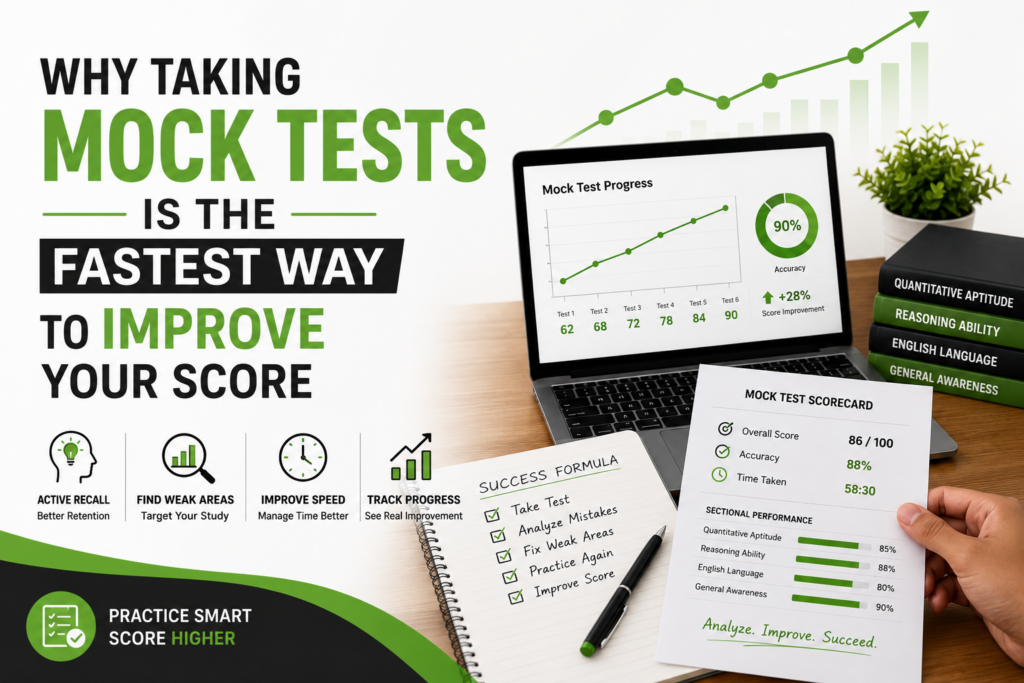
If you had to pick one activity that improves competitive exam scores faster than anything else, it would be taking mock tests — not reading another chapter, not watching another video lecture. This article explains why mock tests outperform passive study methods, backed by how memory, exam skills, and feedback loops actually work.
Editorial Note: This guide is based on established learning principles and practical exam preparation methods. Actual score improvement depends on consistent study, revision, and regular mock-test analysis — mock tests are a powerful tool, not a shortcut that replaces preparation.
Who Should Read This?
Anyone preparing for SSC, banking, railway, defence, judiciary, or civil services exams who wants to understand where to actually spend limited study time for the biggest score improvement.
Studying and Test-Taking Are Different Skills
Knowing a concept and being able to apply it correctly, quickly, and under pressure in an exam are not the same skill. Reading builds recognition — you understand a concept when you see it explained. Mock tests build recall and application — the ability to retrieve the right concept from memory in seconds and apply it to a new question. Competitive exams test the second skill exclusively, which is exactly what passive reading fails to train.
Five Reasons Mock Tests Improve Scores Faster Than Passive Study
1. Active Recall Beats Passive Review
Educational research consistently shows that retrieval practice — testing yourself — improves long-term retention more effectively than passive rereading. Every mock test question you attempt forces active recall, which is why students who practice tests regularly retain concepts longer than those who only revise notes.
2. Mock Tests Reveal Exactly What to Study Next
Reading in a fixed order (chapter 1, then chapter 2) doesn’t account for what you personally already know. A mock test instantly surfaces your actual weak areas — the specific topics, question types, or subjects where you’re losing marks — so your next study session is more targeted instead of generic.
3. Mock Tests Build Time Management Under Pressure
Knowing the syllabus doesn’t guarantee you can finish 100 questions in 60 minutes. Mock tests are the only way to practice pacing, section prioritisation, and decision-making about which questions to skip — all of which directly affect your final score regardless of how much you know. See our speed and accuracy guide for specific techniques.
4. Mock Tests Create a Fast, Measurable Feedback Loop
Passive study gives you no reliable signal of whether it’s working until the real exam. Mock tests give you a score, an accuracy percentage, and a topic-wise breakdown within minutes — a feedback loop tight enough to actually course-correct your preparation while there’s still time.
5. Mock Tests Reduce Exam Anxiety
Students who regularly simulate real exam conditions often become more comfortable with time pressure and the exam environment. While mock tests cannot eliminate stress entirely, they can make the actual exam feel more familiar — you’ve already sat through the format, the timing, and the pressure dozens of times before it counts.
How Much Faster? A Practical Comparison
| Study Method | Builds Knowledge | Builds Recall Speed | Builds Exam Stamina | Gives Measurable Feedback |
|---|---|---|---|---|
| Reading textbooks/notes | Yes | No | No | No |
| Watching video lectures | Yes | No | No | No |
| Topic-wise mock tests | Yes | Yes | Partial | Yes |
| Full-length timed mock tests | Yes | Yes | Yes | Yes |
This doesn’t mean reading and lectures are unnecessary — they’re how you first learn a concept. But once a concept is learned, mock tests are what convert that knowledge into exam-ready performance.
The Mock Test Cycle
Score improvement isn’t a one-time event — it’s a repeating cycle. Every mock test you take should feed directly into the next one:
Study Topic
↓
Take Mock Test
↓
Analyze Mistakes
↓
Revise Weak Areas
↓
Take Another Mock Test
↓
Improve Score
Skipping any step in this cycle — especially the analysis step — is why some students take dozens of mock tests without their score moving. Our mock test analysis guide covers exactly how to run the “analyze mistakes” step properly.
After Every Mock Test: A Simple Checklist
Turn the cycle above into a repeatable habit with this checklist after each attempt:
- Review incorrect answers
- Review guessed answers, even the ones you got right
- Identify weak topics from the section-wise breakdown
- Record your score and accuracy to track trends over time
- Revise the weak concepts you identified
- Take another test once you’ve revised
Ideal Weekly Routine
Here’s a practical weekly rhythm that keeps the mock test cycle moving without burning you out:
| Day | Activity |
|---|---|
| Monday | Learn new topics |
| Tuesday | Topic-wise test |
| Wednesday | Revision |
| Thursday | Topic-wise test |
| Friday | Weak-topic practice |
| Saturday | Full-length mock test |
| Sunday | Review & planning |
Adjust the exact days around your schedule, but keep the underlying pattern: new learning early in the week, tests spaced throughout, and a full-length simulation plus review each weekend. Pair this with a broader daily study timetable if you haven’t built one yet.
How to Use Mock Tests for Maximum Score Improvement
Simply taking tests isn’t enough on its own — how you use them matters. Start with topic-wise tests to reinforce each subject as you finish it, then move to full-length tests once you’ve covered most of the syllabus. If you’re preparing without a coaching institute, see our guide to self-study without coaching for how mock tests fit into a complete self-study system, and avoid the pitfalls covered in our mock test mistakes guide.
Frequently Asked Questions
Can mock tests replace studying the syllabus?
No. Mock tests work best alongside syllabus study, not instead of it. They’re most effective once you have basic familiarity with a topic, at which point they accelerate mastery far faster than continued passive review.
How soon will I see score improvement from mock tests?
Most students see measurable improvement within 3-4 weeks of consistent mock test practice combined with proper review, though this varies by exam and starting point.
Are topic-wise or full-length mock tests better for score improvement?
Both serve different purposes. Topic-wise tests build concept mastery early on; full-length tests build the pacing and stamina needed for the actual exam. Use both across your preparation timeline.
Do mock test scores predict my real exam score accurately?
Not precisely, but the trend is meaningful. Consistent mock test performance combined with detailed review is one of the strongest available predictors of real exam readiness.
How many mock tests should I take every week?
Most aspirants do well with 2-3 topic-wise tests plus one full-length test per week, adjusting the mix as their exam date gets closer and full-length practice becomes more important.
When should I start taking mock tests?
As soon as you’ve covered enough of a topic to attempt questions on it — don’t wait until the syllabus is “finished.” Starting early means weak areas surface while there’s still time to fix them.
Should I repeat the same mock test?
Retaking a test you’ve already reviewed can help confirm a weak area is fixed, but it shouldn’t replace fresh tests — new questions are what reveal gaps a repeated test won’t show.
Is a low mock-test score normal?
Yes, especially early in preparation. A low score simply means there’s more useful information in that test’s analysis — treat it as a diagnostic, not a verdict.
What should I do after every mock test?
Follow the checklist above: review wrong and guessed answers, identify weak topics, log your score, revise, and take another test. The analysis is where the actual score improvement happens, not the test itself.
Ready to Improve Your Score?
Don’t wait until you’ve finished the entire syllabus. Take a diagnostic mock test today, identify your weakest areas, and build your preparation around real data instead of guesswork.
 Southwide Team