10 Common Mistakes Students Make in Mock Tests (And How to Avoid Them)
The 10 most common mock test mistakes that quietly cap your score, and exactly how to fix each one — from exam simulation to answer review to time allocation.

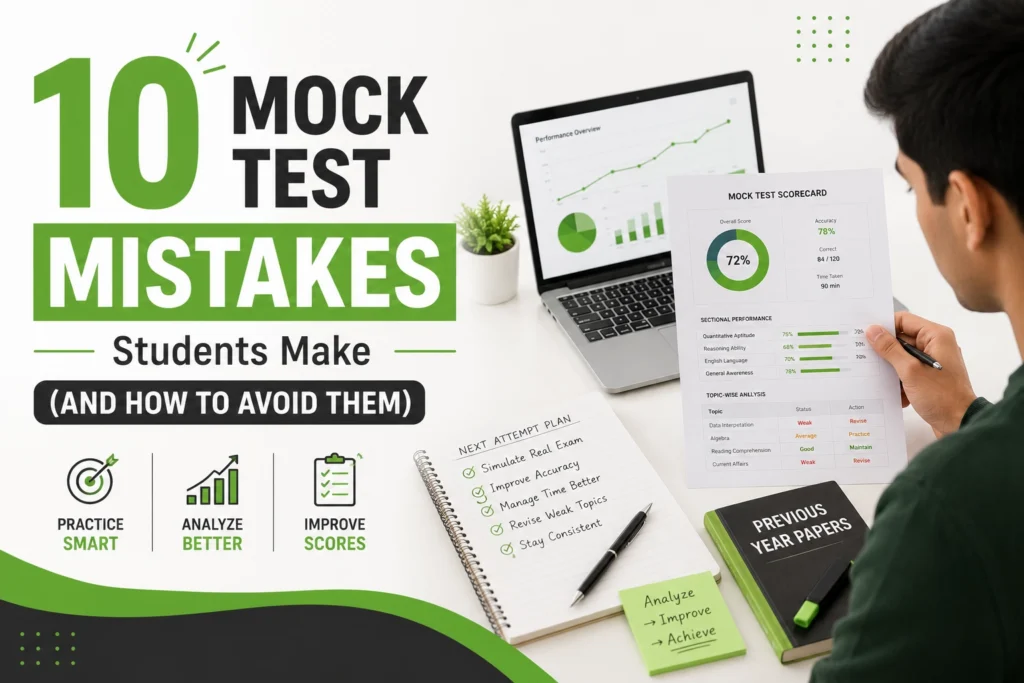
Taking mock tests is one of the highest-leverage things a competitive exam aspirant can do — but only if they’re taken the right way. Many students take dozens of mock tests without improving their score, simply because they’re repeating the same avoidable mistakes every time. Here are the 10 most common mock test mistakes and exactly how to fix each one.
Who Should Read This?
This guide is for anyone preparing for SSC, banking, railway, defence, judiciary, or civil services exams who is already taking (or about to start taking) mock tests and wants to get more value out of every attempt.
Why Mock Test Habits Matter More Than Mock Test Count
It’s tempting to measure preparation by the number of mock tests taken. But taking 50 mock tests carelessly teaches you far less than taking 15 mock tests with proper analysis. The mistakes below are the difference between the two.
10 Common Mock Test Mistakes
1. Not Simulating Real Exam Conditions
Taking a mock test in bed, with your phone next to you, pausing whenever you like, doesn’t build exam stamina or focus. Sit at a desk, set a strict timer, and treat every mock test like the real exam. This is the single biggest predictor of how well your practice transfers to test day.
2. Skipping the Full-Length Test for Only Topic-Wise Practice
Topic-wise tests are useful for building concepts, but only full-length, timed mock tests train you for the actual exam’s pacing, fatigue, and section-switching demands. Balance both — use topic tests early in preparation and shift to full-length tests as the exam approaches.
3. Not Reviewing Wrong Answers Properly
Checking your score and moving on is the most wasted opportunity in exam preparation. Every wrong answer contains information about a specific gap — whether it’s a concept you don’t know, a careless error, or a question you misread under time pressure. Spend at least as much time reviewing a test as you spent taking it.
4. Ignoring the “Why” Behind Correct Guesses
Getting a question right by guessing feels the same as getting it right by knowing the answer — but it isn’t. If you guessed correctly, go back and actually learn the concept. Otherwise, you’ll get the same question type wrong when the guess doesn’t land next time.
5. Poor Time Allocation Across Sections
Spending 40 minutes on a difficult section and rushing through an easy one at the end is one of the most common score killers. Decide your per-section time budget before the test starts, and if a question is taking too long, mark it and move on. See our speed and accuracy guide for section-wise timing strategies.
6. Not Having a Fixed Attempt Strategy
Randomly deciding which questions to attempt during the test wastes time and increases negative marking risk in exams that penalise wrong answers. Decide in advance: attempt your strongest section first, skip anything you’re not at least 50% confident about, and come back to uncertain questions only if time remains.
7. Taking Too Many Mock Tests in a Short Period
Back-to-back mock tests without analysis time in between lead to repeated mistakes instead of corrected ones. Space out full-length tests by at least 2-3 days so you have time to review, identify patterns, and actually apply what you learned before the next attempt.
8. Not Tracking Progress Over Time
A single mock test score tells you very little. What matters is the trend — is your accuracy improving, is your speed improving, are the same mistakes repeating? Keep a simple log of score, accuracy, and time taken for every test so you can see real progress (or catch a plateau early). Our mock test analysis guide covers exactly what to track.
9. Panicking Over a Bad Score
One low-scoring mock test does not predict your real exam outcome, especially early in preparation. Treat every mock test as a diagnostic tool, not a verdict. The goal of a mock test is to expose weaknesses while there’s still time to fix them — a bad score early on is more useful than a good one, because it tells you exactly where to focus.
10. Not Starting Mock Tests Early Enough
Waiting until the syllabus is “fully complete” before taking the first mock test delays the most important feedback loop in your preparation. Start taking topic-wise tests as soon as you finish a topic, and introduce full-length tests once you’ve covered 50-60% of the syllabus.
How to Build a Better Mock Test Habit
Fixing these ten mistakes comes down to one shift: treating every mock test as a two-part exercise — the test itself, and the analysis afterward. The analysis is where the actual improvement happens. A simple weekly routine works well: take 2-3 full-length or topic-wise tests, review each one in detail within 24 hours, log your error patterns, and revise the weak topics before your next test.
Frequently Asked Questions
How many mock tests should I take before my exam?
There’s no fixed number — quality of review matters more than quantity. As a general guide, most successful aspirants take 20-40 full-length mock tests over their preparation period, spaced out with proper analysis in between.
Should I take mock tests even if I haven’t finished the syllabus?
Yes. Topic-wise mock tests as you complete each section help reinforce learning immediately, rather than waiting until the end when early topics have already faded from memory.
Is it normal to score low on early mock tests?
Yes, and it’s expected. Early mock tests are diagnostic tools meant to reveal gaps, not a measure of your final exam performance. Scores typically improve significantly with consistent practice and analysis.
How long should I spend reviewing a mock test?
As a rule of thumb, spend at least as much time reviewing a test as you spent taking it — sometimes more, especially early in preparation when there’s more to learn from each attempt.
Does negative marking change my mock test strategy?
Yes. In exams with negative marking, avoid guessing on questions where you’re not reasonably confident, and use mock tests specifically to calibrate your own confidence threshold for attempting versus skipping a question.
Start Your First (or Next) Mock Test
Put these fixes into practice right away. Start your first mock test on Southwide and apply a proper review routine from day one — it’s the fastest way to turn practice into real score improvement.
 Southwide Team