
8-Hour Study Timetable for Competitive Exam Preparation
If you are preparing full-time, you have the hours — the challenge is using them well. An 8-hour study day gives real room for concept learning, question practice, revision and mock-test analysis, but
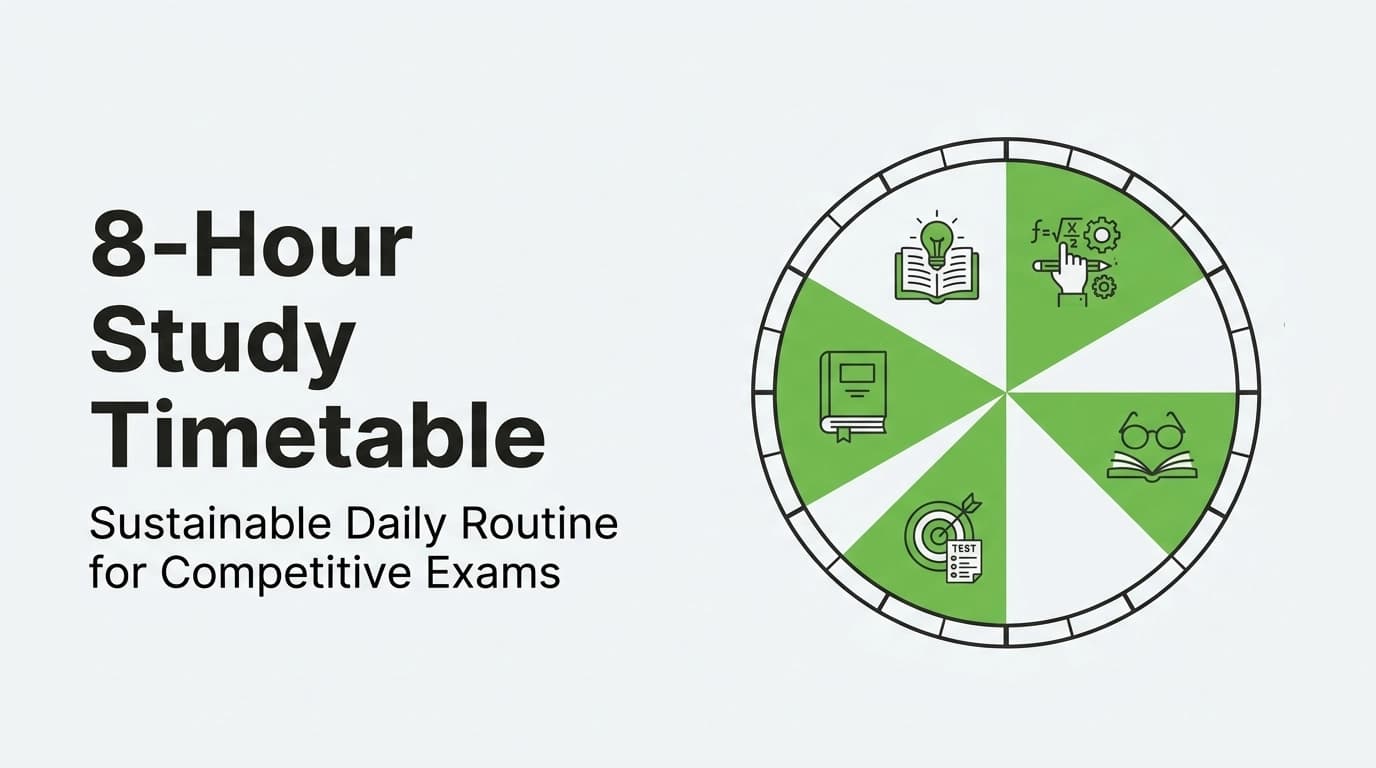
If you are preparing full-time, you have the hours — the challenge is using them well. An 8-hour study day gives real room for concept learning, question practice, revision and mock-test analysis, but only when those hours are structured.
A sustainable 8-hour routine divides the day into four focused two-hour study blocks, structured around mental energy, problem-solving, active recall, and rest.
Editorial Note: There is no universally mandatory number of study hours. Focused, consistent preparation aligned with your target exam's syllabus matters far more than simply recording hours at a desk. Aspirants balancing preparation with college or work should review our adaptable daily study timetable for competitive exams for lighter time budgets.
The 4-Block Daily Structure
Long, uninterrupted study sessions often yield diminishing returns as mental fatigue sets in. Dividing the day into four distinct blocks—separated by substantial breaks—keeps attention sharp across different subjects:
| Block | Focus Area | Purpose |
|---|---|---|
| Block 1 (2 Hours) | Core Theory / Complex Concepts | Learn foundational theory when mental fatigue is lowest |
| Block 2 (2 Hours) | Problem Solving & Applied Skills | Solve timed problem sets in quantitative aptitude or reasoning |
| Block 3 (2 Hours) | Secondary Subject / General Awareness | Review reading-intensive subjects, static GK, or current events |
| Block 4 (2 Hours) | Active Practice, Mocks & Error Review | Test retention under timed conditions and log mistakes |
Within each two-hour block, candidates can use short 5-minute pauses to stretch, drink water, and maintain mental clarity.
Master 8-Hour Timetable (Standard Daytime Routine)
This routine suits full-time aspirants who study best during daytime hours:
| Time Window | Session | Activity & Objective |
|---|---|---|
| 06:30 – 07:00 | Morning Routine | Wake up, hydrate, light physical movement |
| 07:00 – 09:00 | Block 1 (2 Hours) | Core Concept Theory: Cover foundational chapters or difficult concepts while energy levels are fresh. |
| 09:00 – 10:00 | Breakfast & Rest | Nutritious meal; step away from study materials and screens. |
| 10:00 – 12:00 | Block 2 (2 Hours) | Quantitative & Analytical Practice: Solve timed problem sets aligned with your current syllabus module. |
| 12:00 – 14:00 | Lunch & Extended Rest | Lunch, relaxation, or an optional short 20-minute power nap. |
| 14:00 – 16:00 | Block 3 (2 Hours) | Secondary Subject / General Studies: Study GS, English comprehension, or review weekly current affairs. |
| 16:00 – 17:30 | Exercise & Refreshment | Outdoor walk, exercise, or personal leisure to relieve mental strain. |
| 17:30 – 19:30 | Block 4 (2 Hours) | Active Testing & Error Analysis: Attempt topic tests, solve previous-year questions, or review mock solutions. |
| 19:30 – 21:30 | Dinner & Free Time | Dinner, family time, and evening relaxation. |
| 21:30 – 21:45 | Day Close (Optional) | 15-minute review of tomorrow's study priorities. |
Total Tracked Study Time: Exactly 8 Hours.
Alternative: The Early-Riser Schedule
For aspirants who focus best during the quiet hours of early morning:
- 05:00 – 07:00: Block 1 (2 Hours) – Complex theory or challenging analytical topics.
- 07:00 – 08:30: Breakfast, exercise, and household routine.
- 08:30 – 10:30: Block 2 (2 Hours) – Quantitative aptitude or reasoning problem-solving.
- 10:30 – 13:30: Extended break, light reading, lunch, and rest.
- 13:30 – 15:30: Block 3 (2 Hours) – General Studies, static GK, or language practice.
- 15:30 – 16:30: Afternoon tea and physical movement.
- 16:30 – 18:30: Block 4 (2 Hours) – Sectional mock tests, previous-year questions, and error notebook updates.
- Evening: Free for relaxation and personal priorities, heading to bed early to allow around 7–8 hours of sleep.
Alternative: The Late-Start Schedule
For candidates who study more productively later in the day:
- 10:00 – 12:00: Block 1 (2 Hours) – Quantitative aptitude or technical engineering modules.
- 12:00 – 13:30: Lunch, hydration, and mental reset.
- 13:30 – 15:30: Block 2 (2 Hours) – General Studies, reading comprehension, or vocabulary drills.
- 15:30 – 17:00: Exercise, break, and personal errands.
- 17:00 – 19:00: Block 3 (2 Hours) – Topic-wise problem sets and current affairs analysis.
- 19:00 – 20:30: Dinner and break.
- 20:30 – 22:30: Block 4 (2 Hours) – Timed sectional practice, PYQ solving, and error review.
- 22:30 onward: Wind down and maintain a consistent sleep routine.
Balancing Input and Output
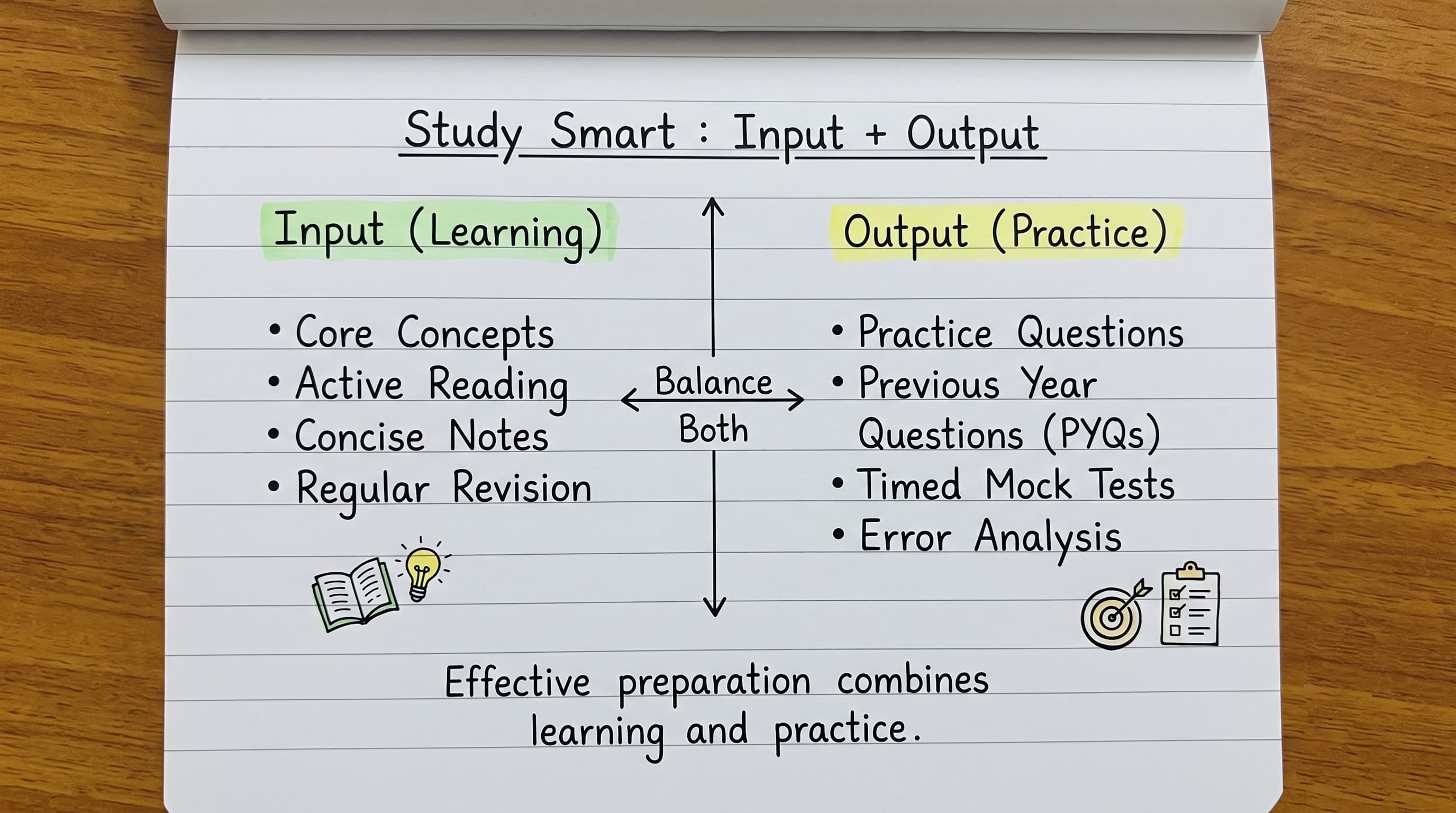
Rereading notes or rewatching lectures feels productive but rarely shows whether you can retrieve and apply the material. Retrieval practice — testing yourself rather than simply rereading — is one of the better-supported study techniques (Dunlosky et al., 2013). To make an 8-hour schedule productive, balance input (learning content) with output (active application):
- Input (Concepts & Content): Reading textbooks, understanding formulas, reviewing editorial analysis, and making brief revision notes.
- Output (Testing & Application): Answering timed questions, attempting sectional quizzes, solving previous-year papers, and updating an error log.
Adapting the Balance Across Your Preparation
- Early Stage (Syllabus Coverage): Roughly 5–6 hours of input and 2–3 hours of output.
- Mid-to-Late Stage (Revision & Testing): Roughly 4–5 hours of output and 3–4 hours of targeted revision — adjusting the split so the total remains around 8 hours.
Subject Rotation Strategy
Spending an entire 8-hour day on a single subject often leads to fatigue and slower learning. Many candidates find it practical to rotate between two or three complementary areas each day:
- Analytical / Numerical Subject: Quantitative Aptitude, Logical Reasoning, or core technical engineering.
- Reading / Conceptual Subject: General Studies, Polity, History, Economy, or General Science.
- Language / Review Work: English comprehension, vocabulary, static GK, or current events.
Integrating Mock Tests and the Error Log
Full-length mock tests can become an important part of preparation once you have covered enough of the syllabus for them to be meaningful:
- Early Preparation: Focus Block 4 on chapter quizzes and sectional practice tests to reinforce newly learned concepts.
- Advanced Preparation: Once you have covered a substantial portion of the syllabus, dedicate one day per week (such as Sunday) to a full-length mock test under exact exam timing.
The 4-Category Error Review
When reviewing practice tests, classify every wrong or skipped question into one of four categories:
- Conceptual Gap: You did not understand the underlying rule or formula. (Action: Revisit textbook notes during Block 1).
- Calculation Error: The concept was correct, but arithmetic slipped. (Action: Practice untimed calculation drills).
- Careless / Reading Error: You knew the concept but misread the question, overlooked a condition, or marked the wrong option. (Action: Slow down during question reading).
- Time Mismanagement: You spent disproportionate time on a difficult question that should have been skipped. (Action: Practice question selection and skipping strategies).
To learn how to extract actionable data from your practice scores, read our comprehensive guide on how to analyze mock test results.
Warning Signs of Overtraining
More study hours do not automatically yield higher marks. Watch for these indicators that your schedule needs adjustment:
- Brain fog: You re-read simple sentences multiple times without retaining the meaning.
- Declining Accuracy: Your careless mistakes increase on familiar topics due to mental fatigue.
- Compromised Sleep: Regularly cutting sleep to extend study hours can affect attention, learning, memory, and daytime performance.
- Adjustment Strategy: If mental fatigue persists, temporarily scale back your daily hours, prioritize adequate sleep and physical activity, and rebuild study volume gradually as energy levels recover.
Frequently Asked Questions
Is an 8-hour study timetable necessary to clear a competitive exam?
No. Eight hours is not a mandatory requirement for clearing an exam. Aspirants managing college, jobs, or family responsibilities can prepare effectively by maintaining consistent, focused study routines within the time they can realistically sustain. Full-time candidates use an 8-hour routine because their daily schedule permits it.
How should I modify this timetable if I attend coaching classes?
If you attend 2 to 3 hours of daily coaching (online or offline), count those class periods toward your input sessions. Use your remaining study blocks for self-study: practicing questions independently, revising class notes, and completing topic tests.
What should I do during study breaks?
Step away from your desk completely. Drink water, stretch, take a short walk, or rest your eyes. Constant digital stimulation during breaks can make it harder to refocus, so keep phones out of reach.
Practice with Southwide
An 8-hour study routine is most effective when paired with active testing. Use your evening practice block to attempt timed sectional tests, measure your accuracy, and review detailed explanations.
Start a Mock Test on Southwide
References
- Learning Science & Retrieval Practice: Dunlosky, J., et al. (2013). Improving Students' Learning with Effective Learning Techniques: Promising Directions from Cognitive and Educational Psychology. Psychological Science in the Public Interest.
The schedules above are Southwide editorial recommendations, not official requirements. This timetable is an adaptable planning framework rather than a rigid rule. Adjust your daily study volume according to your personal health, energy patterns, and target exam deadlines.
Recommended from Southwide
 Study Tips
How to Prepare for Competitive Exams Without Coaching (2026 Guide)
A step-by-step self-study system for cracking SSC, banking, railway, and civil services exams without joining a coaching institute: a self-study timeline, minimum resource list, diagnostic testing, and revision cycles.
9 min read
 Study Tips
10 Common Mistakes Students Make in Mock Tests (And How to Avoid Them)
The 10 most common mock test mistakes that quietly cap your score, and exactly how to fix each one: from exam simulation to answer review to time allocation.
6 min read
 Study Tips
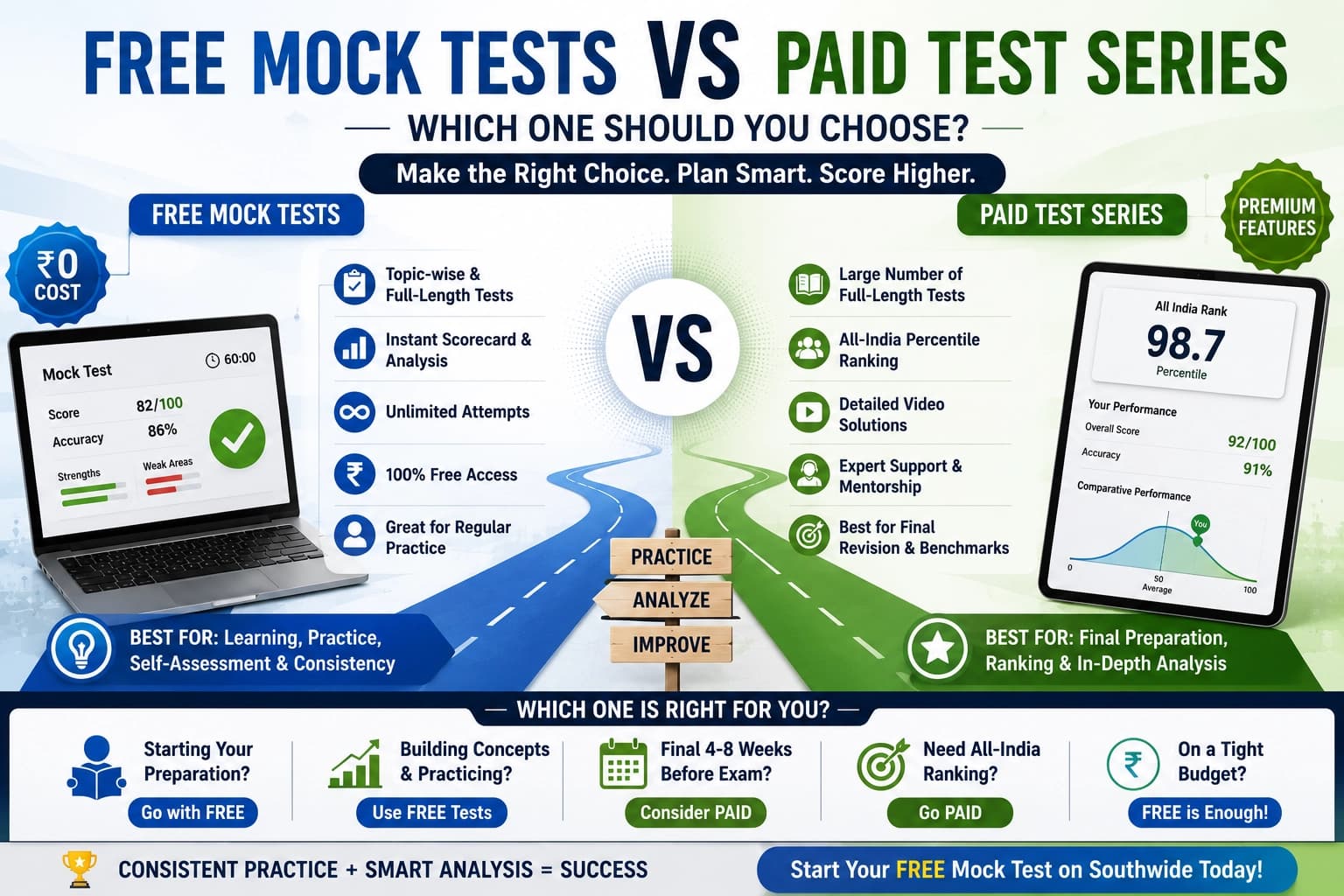
Free Mock Tests vs Paid Test Series – Which One Should You Choose?
An honest, updated comparison of free mock tests and paid test series — with a decision table, a before-you-buy checklist, and how to choose based on your preparation stage.
8 min read