
Which Competitive Exam Should I Prepare For? A Practical Guide to Choosing
Stop preparing for every exam at once. Use this 10-factor decision framework to check eligibility, compare career realities, and choose the right primary exam.
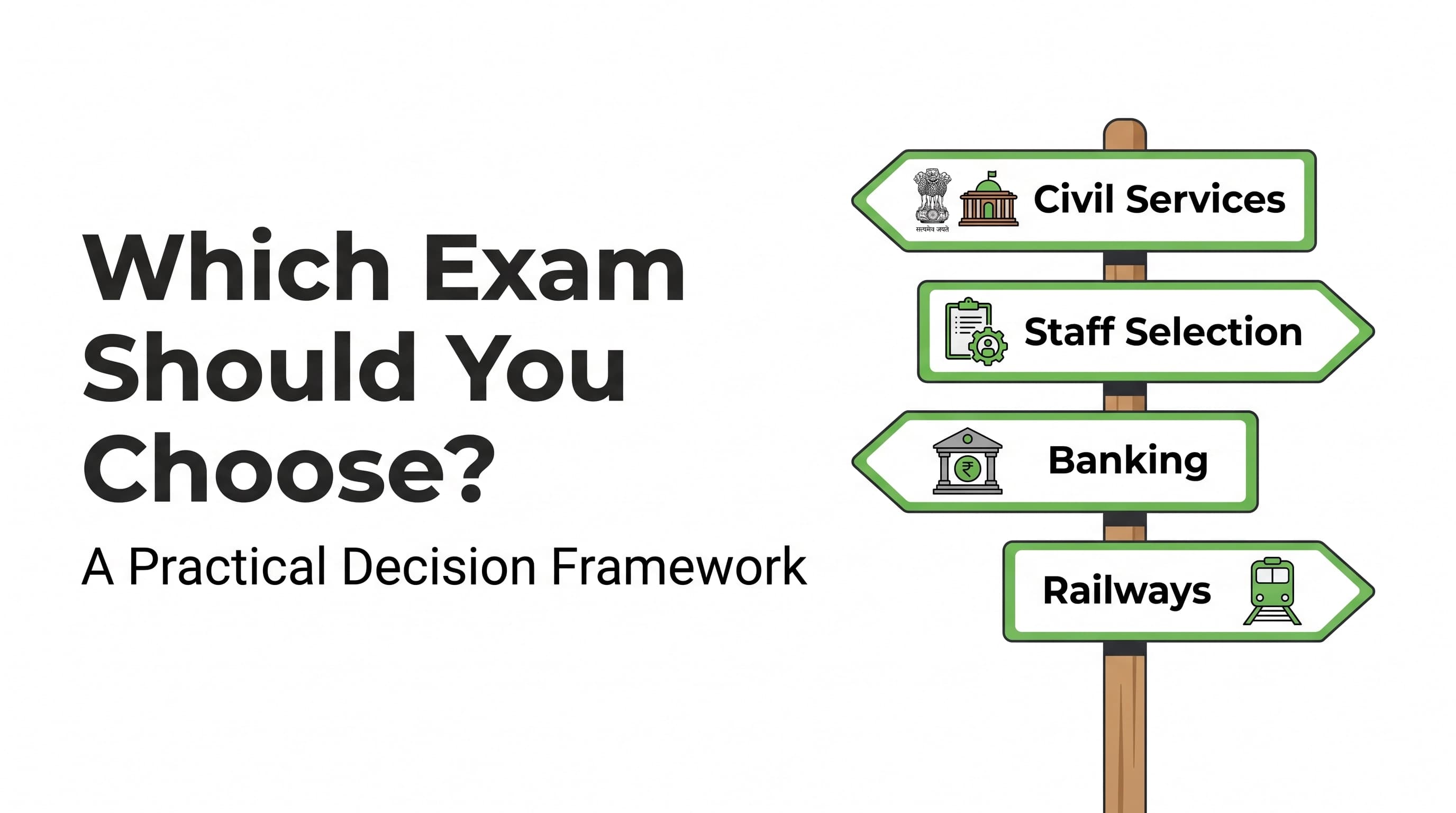
Which Competitive Exam Should I Prepare For? A Practical Guide to Choosing
With many central and state recruitment routes available, aspirants can struggle to decide which exam family deserves their primary focus.
A common misstep is trying to prepare for UPSC Civil Services, SSC CGL, Bank PO, and Railway recruitments all at the same time. Because different exam families emphasize distinct testing formats, syllabus breadths, time constraints, and skill sets, trying to prepare simultaneously for exams with very different syllabi and testing styles can divide preparation time and make consistent progress harder.
No competitive examination is universally "easier" or "better". The right primary target is one whereyou satisfy the official eligibility conditions,the tested subjects align with your strengths, andthe working environment matches your career expectations.
Editorial Note:Eligibility criteria, exam patterns, selection stages, syllabi, and recruitment frequencies are set by the respective conducting bodies and change across recruitment cycles. This guide offers an adaptable decision framework to help you evaluate your preparation profile. Always consult the latest official notifications before applying.
The 10-Factor Decision Framework
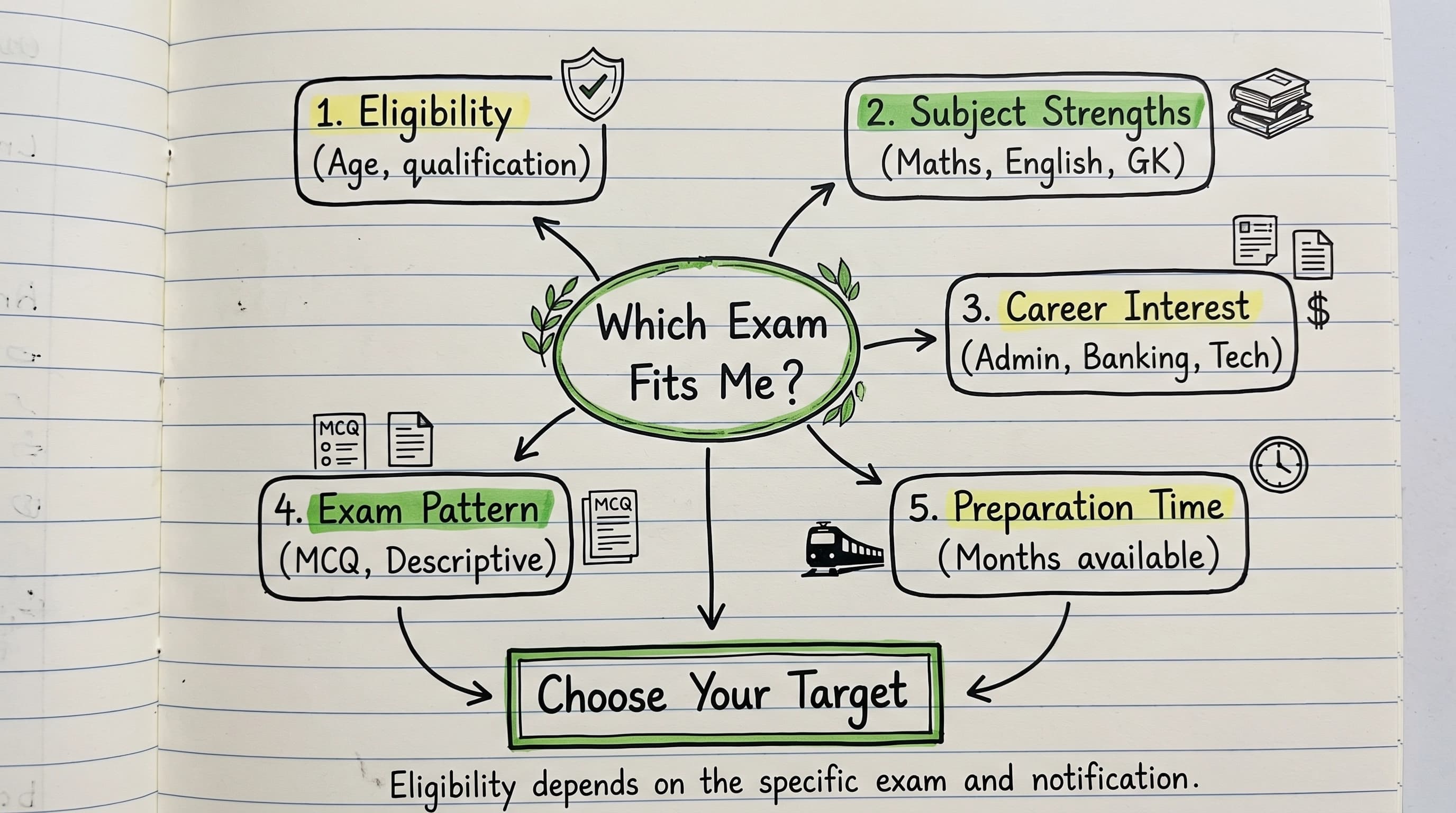
To choose a primary target systematically, evaluate your profile across ten essential factors:
- Educational Qualification:Bachelor's degree (any discipline vs. specific technical/professional stream), 10+2, or diploma.
- Age & Cut-Off Windows:Current age relative to category-specific minimum and maximum cut-off dates.
- Selection Stages:Single-tier computer-based test versus multi-stage preliminary, mains, descriptive, skill, or interview rounds.
- Subject Strengths:Mathematical aptitude, reasoning, reading comprehension, writing ability, or general studies depth.
- Exam Pattern & Time Pressure:Rapid sectional speed-drills versus long-form analytical and descriptive answer-writing.
- Career & Work Environment:Public administration, desk administration, customer-facing operations, compliance, or field duties.
- Posting & Transfer Realities:All-India transfers, regional state posting, rural/semi-urban rotations, or central ministry locations.
- Recruitment Predictability:Annual scheduled calendars versus cycle-dependent or periodic recruitments.
- Available Preparation Time:Daily sustainable study hours balanced against current academic, professional, or family responsibilities.
- Preparation Overlap:Compatibility with realistic secondary backup exams sharing common syllabus areas.
Step 1: First Check — Are You Actually Eligible?
Before assessing career interests or study plans, verify that you meet the mandatory eligibility conditions set out in the official notification:
- Educational Criteria:Most central and state officer-level recruitments (such as UPSC CSE, SSC CGL, and IBPS PO) require a recognized bachelor's degree. Certain recruitments require specific degrees or subjects (such as engineering for technical posts, commerce or economics for statistical or audit cadres, or law for legal posts).
- Age & Date-of-Birth Cut-Offs:Check the official date-of-birth window in the current notification. Minimum and maximum age rules vary by recruitment and category relaxations.
- Physical & Medical Standards:Some uniformed, enforcement, and field-oriented posts include physical, medical, or post-specific standards. These requirements vary by recruitment, post, category, and notification, so verify the exact standards before selecting an exam as a target.
- State-Specific Conditions:State recruitment rules can include regional-language requirements, local/reservation provisions, or other state-specific eligibility conditions depending on the post and recruiting authority. Check the applicable notification rather than assuming the same rules apply across states.
- Attempt Limits:Certain recruitments (such as UPSC Civil Services) enforce strict limits on the number of attempts permitted per candidate category.
If you do not satisfy every mandatory condition for an exam, eliminate it from your target list immediately.
Step 2: Understand Tested Skill Profiles
Different exam families evaluate different combinations of academic and cognitive skills. Rather than viewing exams through broad stereotypes, examine what the syllabi and patterns actually assess:
Exam Family — Core Tested Components — Testing Style & Considerations
Banking & Financial (IBPS, SBI, Insurance) — Quantitative Aptitude, Reasoning Ability, English Language, General/Financial Awareness. — Objective tests under tight sectional time limits. Emphasizes rapid arithmetic interpretation, complex logical arrangements, and current financial developments.
Central Staff Selection (SSC CGL, CHSL) — Mathematical Abilities, Reasoning, English, General Awareness. Tier II includes mandatory qualifying modules. — Balances arithmetic and secondary-school mathematics (geometry, algebra, trigonometry) with static and dynamic general awareness. Tier II includes Computer Knowledge and Data Entry Speed Test (DEST) requirements.
Civil Services & State Administration (UPSC CSE, State PSCs) — Objective Preliminary screening (General Studies & Aptitude) followed by multi-paper Descriptive Mains (Essay, General Studies, Optional) and Interview. — Emphasizes reading depth, conceptual clarity, interdisciplinary understanding, and structured written expression across political, economic, historical, and social topics.
Regulatory & Development Bodies (e.g., RBI Grade B, SEBI) — Phase-I objective aptitude screening followed by Phase-II combination of objective and descriptive papers in specialized areas. — Requires general aptitude for screening, followed by subject depth in Economic and Social Issues, Financial Management, or specialized securities regulations.
Railway Recruitment (e.g., RRB NTPC, Level-1) — Testing structure and syllabus vary by CEN and post. Common areas can include mathematics, reasoning, and general awareness, while Level-1 and other recruitments may include additional subject areas such as general science. — Multi-stage objective computer-based tests evaluating fundamental arithmetic, general reasoning, and broad factual knowledge. Check the current notification for exact syllabus parameters and post-specific stages.
Step 3: Compare Career Environments and Working Realities
Choosing an exam means choosing the daily work environment that follows selection. Consider the day-to-day responsibilities of different cadres:
Central Administration & Desk Roles (e.g., SSC CGL ASO Cadres)
Recruits work across Central Government ministries and attached offices. Responsibilities typically involve file processing, administrative coordination, and policy documentation. Postings are often concentrated in major administrative centers, though specific locations depend on the allotted cadre and department.
Field Inspection & Enforcement (e.g., Central GST, Preventive Officer, Police SI)
Involves regulatory oversight, taxation audits, customs compliance, or law enforcement. These roles require field inspections, direct public interaction, and varying working hours depending on operational requirements.
Banking Operations & Management (e.g., IBPS, SBI PO)
Involves branch-level operations, commercial lending, credit evaluation, account servicing, and customer management. Officers work within structured institutional guidelines, with duties, targets, and transfer frequencies determined by the individual bank's operational policies.
Public Administration & Policy Governance (e.g., UPSC CSE, State Administrative Services)
Involves district administration, revenue management, development program implementation, and law-and-order supervision. These positions carry substantial public responsibility, require direct engagement with community challenges, and involve regular postings across districts.
Step 4: Evaluate Recruitment Predictability and Selection Stages
When planning your preparation, factor in how regularly recruitments occur and how many selection stages you must complete:
- Examination Calendars:UPSC publishes an annual examination calendar, and IBPS releases tentative annual schedules for its Common Recruitment Processes (CRP). These schedules outline notification and examination windows for participating organizations. Other recruitment bodies may release notifications periodically based on sanctioned departmental vacancies.
- Selection Timelines:A published examination schedule does not guarantee appointment within a specific number of months. Multi-stage recruitments may involve preliminary examinations, mains papers, interviews, physical or medical tests, skill tests, and document verification. Consider the number and type of stages, but do not assume that a published calendar guarantees a particular completion timeline.
Step 5: Plan Preparation Overlap (Primary Target + Compatible Options)
Preparing effectively requires choosingone primary targetthat receives your full daily attention. Secondary exams should only be considered if their syllabus areas and testing formats share meaningful common ground:
Primary Target — Compatible Secondary Options — Shared Preparation Areas — What Requires Separate Study
SSC CGL — SSC CHSL, selected RRB NTPC posts, State SSC exams — Quantitative Aptitude, Logical Reasoning, General English, Static GK — Target-specific post criteria, typing benchmarks, or state-specific General Studies modules
IBPS PO — SBI PO, IBPS / SBI Clerk, nationalized insurance recruitments — Quantitative Aptitude, Reasoning Puzzles, English, Banking & Current Affairs — Exam-specific question patterns, sectional weightages, or specialized insurance topics
UPSC Civil Services — State PSC Administrative Services, CAPF (Assistant Commandant) where eligible — Core General Studies (Polity, Economy, History, Geography, Environment), Essay writing — State-specific history, geography, and local regulations; service-specific physical or paper requirements
Selecting an unrelated secondary exam—such as pairing UPSC Civil Services with Bank PO—requires preparing for two fundamentally different formats at once: long-form analytical essay writing alongside high-speed arithmetic and puzzle solving. Focus on your primary target first before adding secondary options.
How to Use Diagnostic Mock Tests
A diagnostic test should not be used as an absolute career verdict, nor does it define your long-term potential. Instead, a diagnostic test provides aninitial performance baselinethat reveals your starting familiarity with an exam's format:
- Select one or two exam families you are eligible for and considering targeting.
- Attempt one authentic previous-year question paper or standard introductory mock test under official timing constraints without consulting notes.
- Review your performance objectively:
- Combine this diagnostic baseline with your educational background, career preferences, and available study hours to finalize your decision.
The Self-Assessment Decision Worksheet
Use this practical framework to record your preferences and select your primary target:
Step 1: Confirmed Eligible Exams (Meet all age, degree, physical criteria):
_______________________________________________________________
Step 2: Preferred Work Setting (Desk/Policy vs. Field/Uniformed vs. Banking):
_______________________________________________________________
Step 3: Strongest Academic / Cognitive Areas (Quant, Reasoning, GS, Writing):
_______________________________________________________________
Step 4: Acceptable Selection Structure (Objective CBT vs. Multi-Tier Descriptive):
_______________________________________________________________
Step 5: Sustainable Daily Study Hours Available:
_______________________________________________________________
Step 6: Diagnostic Test Baseline Observations:
_______________________________________________________________
FINAL PRIMARY TARGET: _________________________________________________
COMPATIBLE SECONDARY BACKUPS (Sharing core syllabus): ___________________
Frequently Asked Questions
Which competitive exam is easiest to crack?
No government recruitment examination is universally easy. High applicant numbers make even entry-level recruitments competitive. Exams with structured objective syllabi and predictable recruitment schedules may allow for more straightforward preparation planning than multi-stage examinations with subjective written papers, but success depends on individual preparation, accuracy, and syllabus coverage.
Can I prepare for SSC and Banking examinations at the same time?
While both test quantitative aptitude, reasoning, and English, their testing emphasis differs. Banking recruitments emphasize high-speed data interpretation, complex reasoning puzzles, and dynamic financial awareness under strict sectional time limits. SSC examinations evaluate secondary-school mathematics (including geometry, algebra, and trigonometry) alongside static general awareness and qualifying skill components. It is generally more effective to establish a solid foundation in your primary target before attempting the other.
How much preparation time is required to prepare for a competitive exam?
There is no fixed preparation timeline. The time required depends on your starting academic baseline, familiarity with the syllabus, daily sustainable study hours, target exam pattern, and the number of selection stages involved. Review the official syllabus, take a diagnostic test to identify knowledge gaps, and design a study routine that fits your schedule.
Practice with Southwide
Once you have identified your primary target, take a diagnostic practice test to benchmark your baseline accuracy, understand question formats, and review detailed explanations.
Start Practising with Free Southwide Mock Tests
Official Sources
- Union Public Service Commission (Examination Calendars & CSE Regulations):upsc.gov.in
- Staff Selection Commission (CGL Notice, DEST & Module Requirements):ssc.gov.in
- Institute of Banking Personnel Selection (Tentative CRP Calendars):ibps.in
- Reserve Bank of India Opportunities (Grade B Regulations & Phase-II Patterns):rbi.org.in
- Railway Recruitment Control Board:indianrailways.gov.in
Last reviewed: September 2026. Recruitment calendars, eligibility rules, and examination patterns change by notification cycle. Candidates should verify the latest official notifications issued by the conducting authorities.
Recommended from Southwide
 Government Exams
Competitive Exams After 10th in India: Government Jobs & Career Pathways
Completing Class 10 (Matriculation) is an important academic milestone. Many students look ahead to understand what public-sector recruitments or vocational training routes exist at this stage.
5 min read
 Study Tips
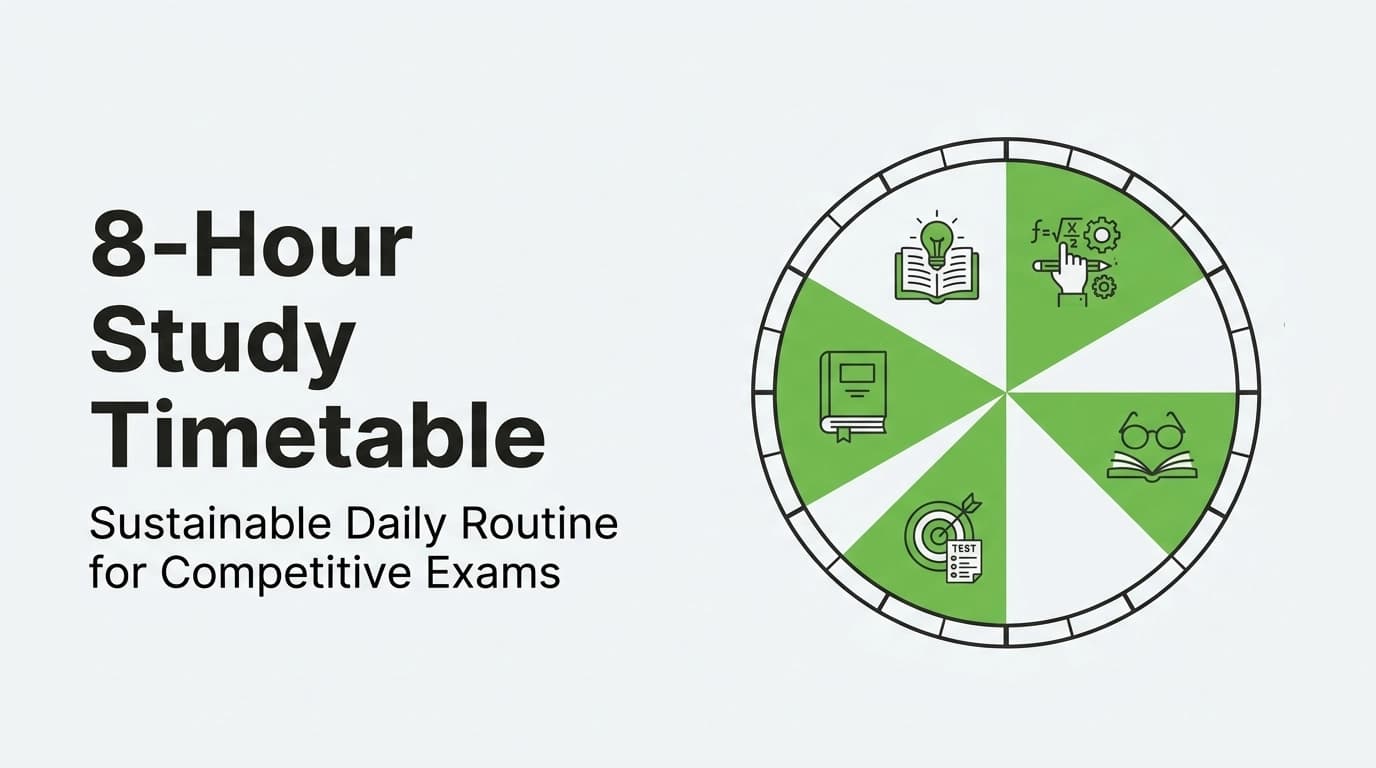
8-Hour Study Timetable for Competitive Exam Preparation
If you are preparing full-time, you have the hours — the challenge is using them well. An 8-hour study day gives real room for concept learning, question practice, revision and mock-test analysis, but
5 min read
 Study Tips
How to Prepare for Competitive Exams Without Coaching (2026 Guide)
A step-by-step self-study system for cracking SSC, banking, railway, and civil services exams without joining a coaching institute: a self-study timeline, minimum resource list, diagnostic testing, and revision cycles.
9 min read