
Competitive Exams for B.Tech Graduates in India: Government, Banking, PSU & Technical Options
Compare technical and general competitive exam pathways for B.Tech graduates, from GATE and ESE to SSC CGL, banking, civil services and defence.
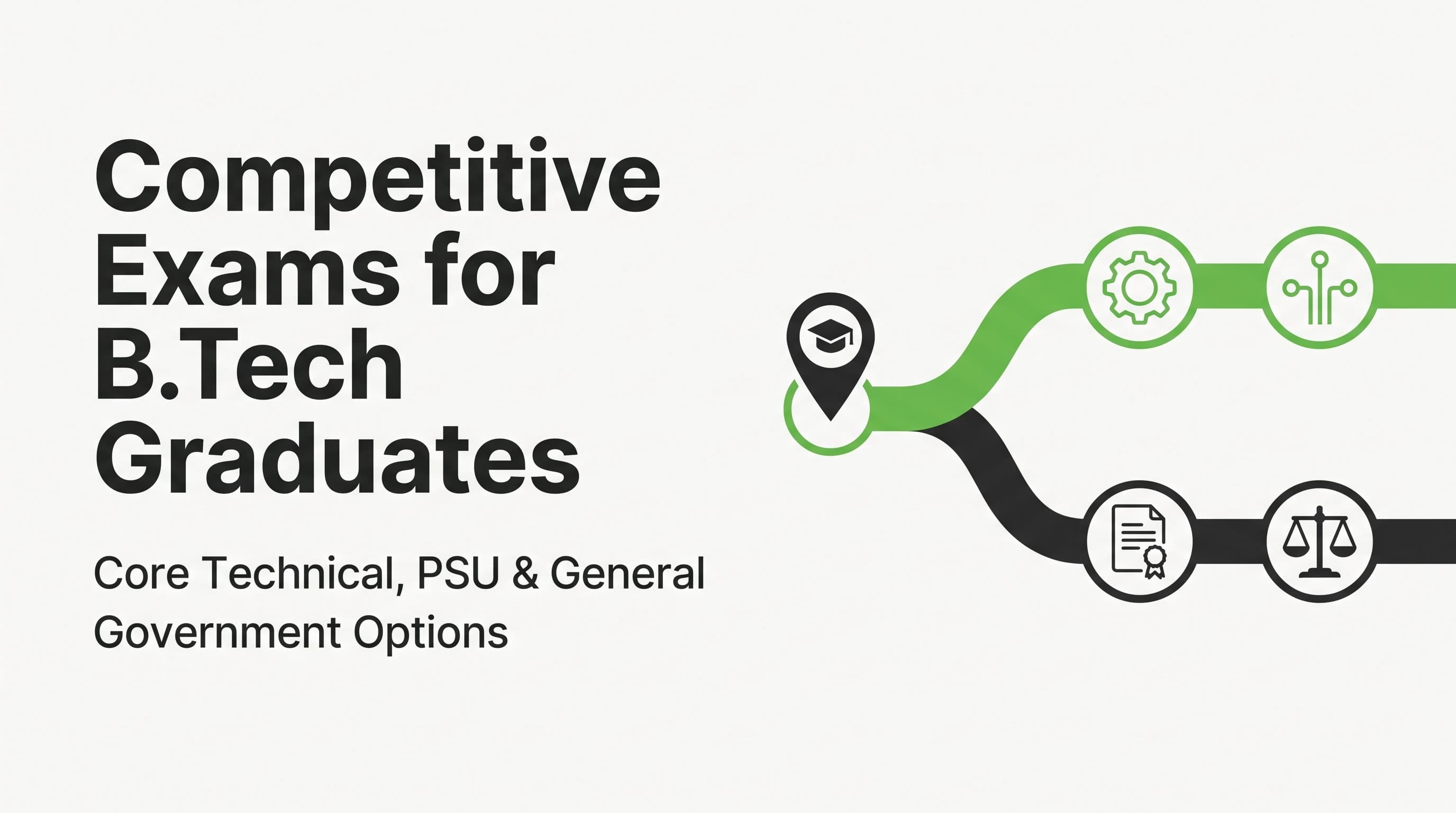
Engineering graduates in India occupy a distinct position when planning competitive exam preparation: a recognized B.E. or B.Tech degree can fulfill the basic graduation requirement for general graduate-level recruitments, while also opening technical and engineering examinations.
However, many engineers attempt to prepare for both tracks at the same time. Balancing core engineering theory with speed-based banking puzzles or extensive general studies often divides attention and slows preparation across both.
To make an informed decision, candidates need to understand the two main options available to engineering graduates: The Core Technical Route and The General Graduate Route.
Editorial Note: Recruitment methods across Public Sector Undertakings (PSUs), government departments, and research organizations change periodically. While some organizations use GATE scores to shortlist candidates, others conduct independent computer-based examinations or interviews. Candidates should verify the latest official notification from the hiring authority before beginning preparation.
Career Options for B.Tech Graduates at a Glance
| Route | Representative Examples | Uses Engineering Discipline? | Primary Check for Candidates |
|---|---|---|---|
| Technical Examinations | GATE, UPSC ESE | Yes | Check whether your engineering branch has an eligible category or paper. |
| Public Sector Enterprises | Organization-specific PSU recruitment | Often | Check the current notification for the required recruitment method (GATE vs. independent CBT). |
| Scientific & Research Bodies | ISRO, DRDO, BARC pathways | Usually | Verify eligible engineering branches and selection stages in the notification. |
| General Graduate Recruitment | SSC CGL, Banking (IBPS / SBI) | Usually no | Verify graduation criteria alongside post-specific conditions (age, subjects, skill tests). |
| Civil & Administrative Services | UPSC CSE, State PSCs | Mostly no | Review the complete syllabus, optional subjects, and multi-tier examination stages. |
| Defence Officer Cadres | CDS, AFCAT, Technical Entries | Depends on entry | Verify branch, age, 10+2 subject criteria, and physical/medical standards. |
1. Core Technical Opportunities for Engineers
If you want to work in core engineering, design, operations, or technical administration, the following avenues apply:
A. Graduate Aptitude Test in Engineering (GATE)
GATE is a national-level examination administered jointly by the Indian Institute of Science (IISc) and seven Indian Institutes of Technology (IITs). While primarily used for admission to postgraduate and doctoral programmes, it is also used by some public sector organizations as part of their recruitment process.
- Public Sector Recruitment: A number of PSUs and government organizations have used GATE scores to shortlist candidates for executive trainee or graduate engineer trainee positions.
- Selection Process: Where an organization uses GATE, it may shortlist candidates using the relevant GATE paper or score and then conduct additional selection stages specified in its notification—such as personal interviews, group discussions, document verification, or medical checks.
- Important Distinction: Participating organizations, cut-offs, and eligible GATE papers can change by recruitment cycle. Qualifying in GATE does not guarantee public sector employment; each hiring body issues its own recruitment notification with its own eligibility conditions and deadlines.
B. UPSC Engineering Services Examination (ESE)
The Union Public Service Commission conducts the Engineering Services Examination for recruitment to specified engineering services and posts under the Government of India:
- Examination Categories: ESE is currently conducted for four engineering categories: Civil Engineering, Mechanical Engineering, Electrical Engineering, and Electronics & Telecommunication Engineering.
- Selection Process: A three-stage evaluation comprising a Preliminary Examination (General Studies & Engineering Aptitude plus discipline-specific objective papers), a Mains Conventional/Descriptive Technical Examination, and a Personality Test (Interview).
- Branch Applicability: Candidates whose degree title differs from the four notified categories must review the educational-qualification and equivalence provisions in the official UPSC notification to determine whether they meet the criteria for a particular category or service.
C. Scientific & Research Organizations
Organizations such as the Indian Space Research Organisation (ISRO), Defence Research and Development Organisation (DRDO), and Bhabha Atomic Research Centre (BARC) conduct technical and scientific recruitments through their own programmes and notifications. Post designations, eligible engineering disciplines, and selection methodologies vary: depending on the organization and recruitment cycle, selection may involve an independent written examination, GATE-based shortlisting, an interview, or a combination of stages.
D. Junior Engineer & State Technical Posts
- SSC Junior Engineer (JE): Recruits Junior Engineers for participating Central Government departments. Eligible qualifications generally include relevant engineering degrees or diplomas depending on the department and post. Candidates should review the current SSC JE notification for post-specific requirements.
- State Engineering Services (Assistant Engineer / Executive Engineer): Administered by respective State Public Service Commissions for engineering departments (such as irrigation, public works, and rural engineering). Recruitment criteria, domicile provisions, and local language requirements vary by state and post.
2. General Graduate Opportunities for Engineers
A recognized B.E. or B.Tech degree can satisfy the basic graduation requirement for many general competitive examinations. However, individual recruitments or specific posts within an examination may require additional criteria, such as specific subjects, age limits, minimum marks, or practical skill tests.
| Exam Category | Representative Recruitments | Preparation Considerations for Engineers |
|---|---|---|
| Central Administration | SSC CGL (Combined Graduate Level) | Recruits for various Group B and Group C posts across Central ministries and departments. Engineering graduates may be familiar with some quantitative concepts, but complete preparation requires covering the entire syllabus, including Mathematical Abilities, Reasoning, English, General Awareness, Computer Knowledge, and applicable qualifying skill-test requirements under the current notification. |
| Banking Management | IBPS PO, SBI PO | IBPS conducts recruitment for participating public sector banks through its Common Recruitment Process, while SBI conducts recruitment independently. Emphasizes quantitative aptitude, reasoning puzzles, and English under timed conditions. |
| Regulatory & Development Bodies | RBI Grade B, SEBI Grade A, NABARD | Recruit for regulatory, financial, supervisory, or developmental functions depending on the organization. Examination structure, specialist papers, and selection stages vary by organization, stream, and recruitment cycle. Candidates should review the current RBI, SEBI, or NABARD notification for the applicable syllabus and process. |
| Civil & Administrative Services | UPSC CSE, State PSC Group Services | Leads to administrative leadership cadres (such as IAS, IPS, and State Civil Services). Requires extensive descriptive answer-writing, interdisciplinary general studies, essay papers, and an optional subject. |
| Defence Officer Entries | UPSC CDS, AFCAT, Service Entries | Engineering graduates may be eligible for various officer-entry schemes across the Army, Navy, and Air Force. Eligibility varies significantly by entry, branch, age, 10+2 subject background, and physical/medical standards. |
Technical vs. Non-Technical: How to Choose
To decide between a core technical path and a general graduate path, evaluate your profile against three practical considerations:
1. Interest in Core Engineering vs. Public Administration
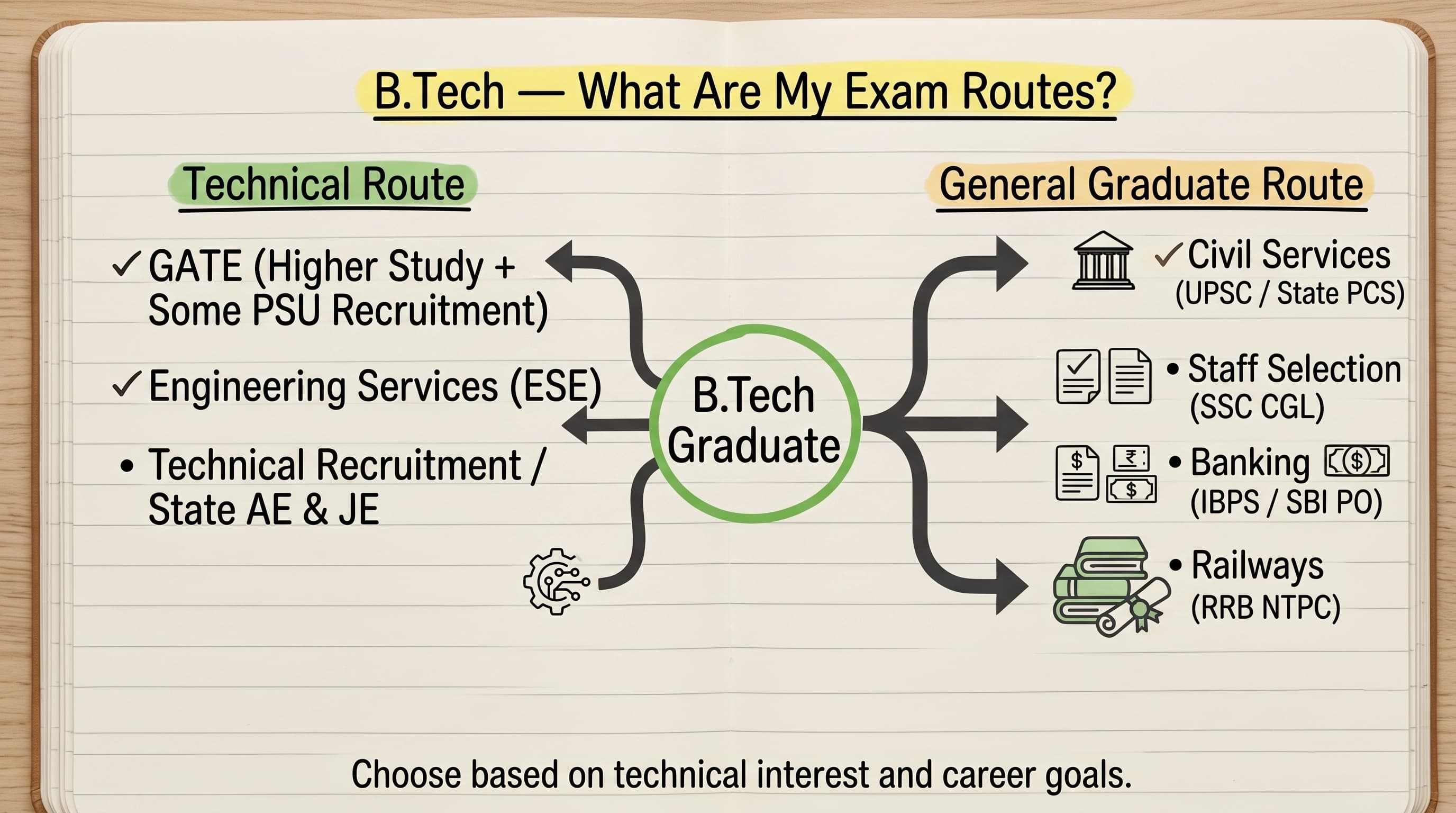
If you enjoy engineering problem-solving, design, or applied technology, preparing for GATE, ESE, or scientific recruitment allows you to build directly on your undergraduate foundation. If you do not plan to pursue a technical career, general graduate-level routes (such as SSC CGL, banking, or civil services) allow you to direct your study time toward general aptitude, administration, and public policy instead.
2. Available Opportunities in Your Engineering Discipline
Technical recruitment opportunities vary by engineering discipline and recruitment cycle. Infrastructure-focused departments frequently recruit Civil, Electrical, and Mechanical engineers through ESE, SSC JE, and state public works departments, while other organizations specify disciplines like Computer Science, Electronics, or Data Science for technical roles. Before committing to a technical track, check which current notifications and GATE papers accept your specific branch.
3. Sustainable Study Requirements
Rather than planning around fixed preparation timelines, evaluate the scope of the syllabus against your available daily study time:
- Core Technical Routes: Require deep mastery of multi-year undergraduate engineering subjects alongside engineering mathematics.
- General Aptitude Routes: Require consistent practice in numerical aptitude, reasoning, language comprehension, and dynamic general awareness.
Candidates can take an introductory practice paper or previous-year test to assess their current baseline across both formats before selecting a primary path. For a structured routine, consult our guide to building an adaptable daily study timetable.
Frequently Asked Questions
Can an engineering graduate apply for SSC CGL or Bank PO?
Yes. A recognized B.E. or B.Tech degree generally satisfies the graduation requirement for SSC CGL and banking examinations like IBPS PO and SBI PO. Candidates must still satisfy age criteria, cut-off dates, and any post-specific conditions outlined in the current notification.
Does every PSU recruit through GATE?
No. Some PSUs and public-sector organizations use GATE scores for specified recruitments, while others use independent written tests, interviews, or alternative selection methods. An organization that used GATE in a past cycle may adjust its recruitment method or eligible disciplines in later notifications, so candidates should always check the hiring body's current notice.
Is UPSC ESE open to all engineering branches?
The UPSC Engineering Services Examination currently conducts examinations for four categories: Civil, Mechanical, Electrical, and Electronics & Telecommunication Engineering. Candidates with degrees in other engineering disciplines should review the educational eligibility and equivalence conditions in the official UPSC notification to verify whether their qualification qualifies for an eligible category or post.
Practice with Southwide
Whether you are preparing for quantitative aptitude and reasoning for general graduate exams or practicing screening papers for technical tests, measure your speed and accuracy under timed conditions.
**Start Practising with Free Southwide Mock Tests**
Official Sources
- Union Public Service Commission (ESE & CSE Regulations): upsc.gov.in
- Staff Selection Commission (CGL & JE Notices): ssc.gov.in
- GATE Official Portal (administered rotationally by IITs/IISc): gate2026.iitr.ac.in (and respective annual host institutes)
- Institute of Banking Personnel Selection: ibps.in
- Official recruitment and career portals of individual PSUs and research bodies (such as ISRO, DRDO, and BARC)
Last reviewed: September 2026. Eligibility rules, selection methods, and recruitment terms vary by notification cycle. Candidates should verify all details with the relevant recruiting authority before applying.
Recommended from Southwide
 Study Tips
Which Competitive Exam Should I Prepare For? A Practical Guide to Choosing
Stop preparing for every exam at once. Use this 10-factor decision framework to check eligibility, compare career realities, and choose the right primary exam.
5 min read
 Government Exams
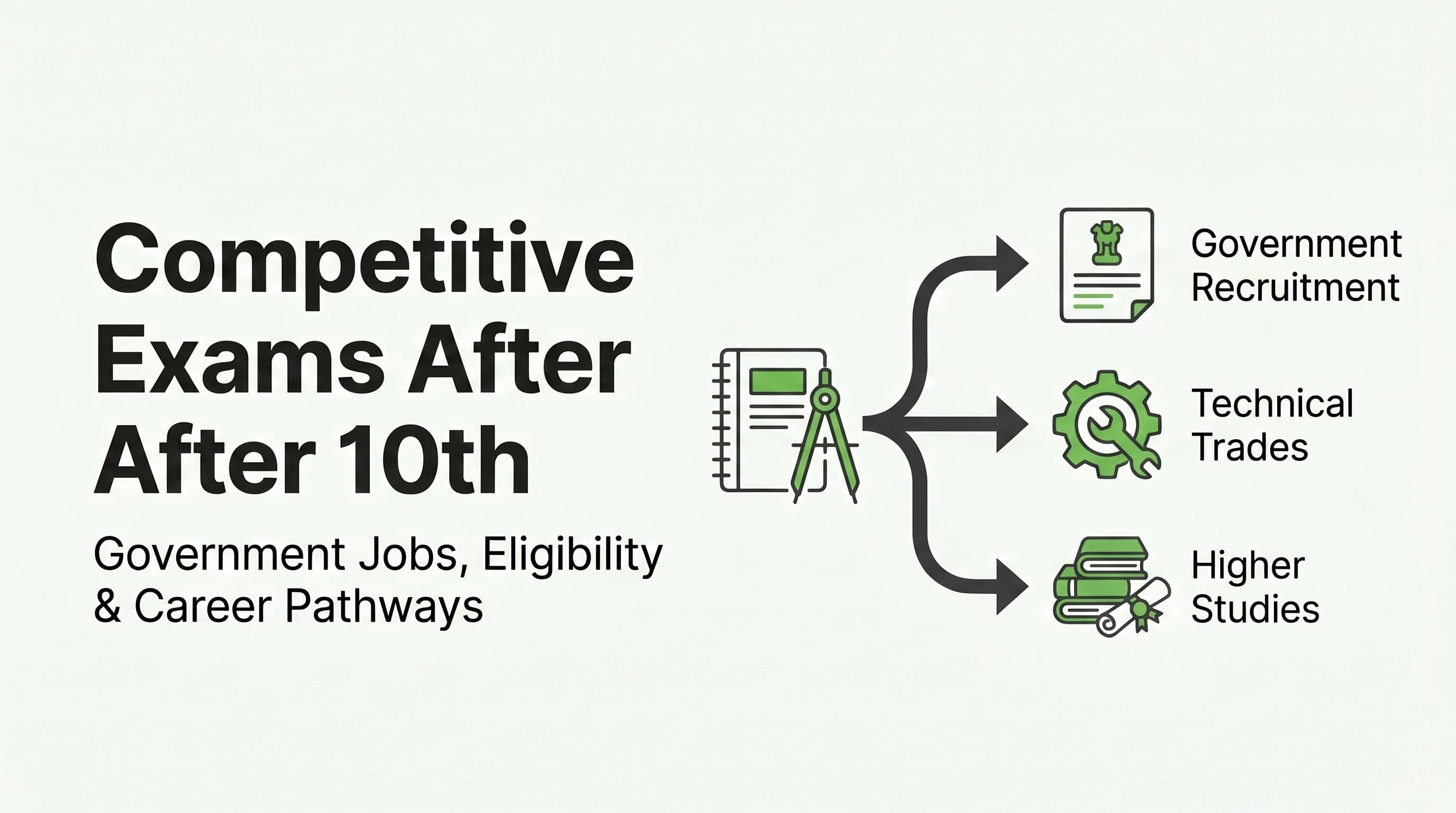
Competitive Exams After 10th in India: Government Jobs & Career Pathways
Completing Class 10 (Matriculation) is an important academic milestone. Many students look ahead to understand what public-sector recruitments or vocational training routes exist at this stage.
5 min read
 Study Tips
8-Hour Study Timetable for Competitive Exam Preparation
If you are preparing full-time, you have the hours — the challenge is using them well. An 8-hour study day gives real room for concept learning, question practice, revision and mock-test analysis, but
5 min read